

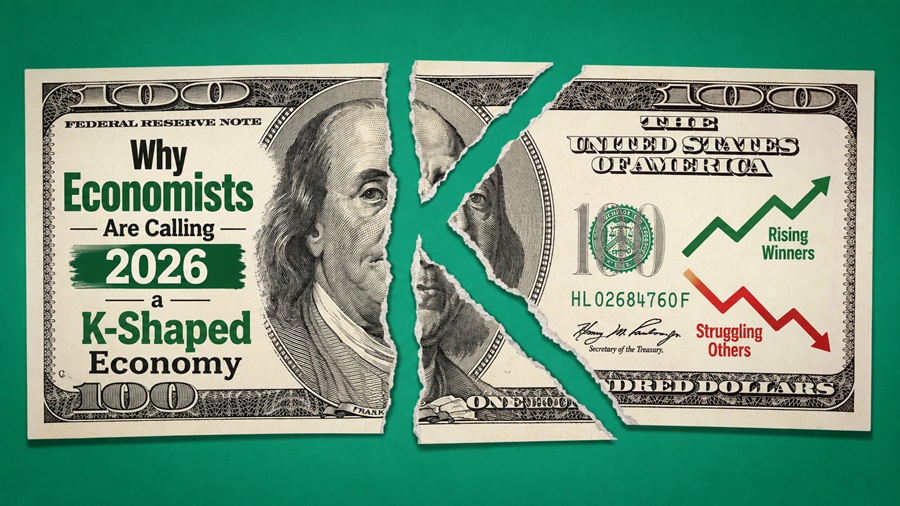
Open the business headlines and the economy looks fine. Open your own budget and it might feel like something else entirely. That gap is not in your head. Economists have a name for it now: a K-shaped economy, where one part of the country is accelerating and another part is standing still, and 2026 is turning into the clearest example of it in years.
What Does “K-Shaped” Actually Mean?
Picture the letter K. One arm rises. One arm falls. That is the shape economists borrow to describe an economy where growth is not lifting everyone at the same time, the way a traditional recovery would. Instead, one segment, often higher income households, tech heavy industries, and investors, keeps climbing, while another segment, often lower and middle income consumers, small businesses, and labor intensive sectors, flattens out or slides backward.
The term first caught on describing the uneven pandemic recovery, when remote friendly, asset owning households bounced back fast while service workers and small businesses struggled for years. What is different in 2026 is the engine behind the split. This time it is artificial intelligence spending, not a pandemic, doing most of the pulling.
Why Is the Economy Splitting in Two Right Now?
Businesses are pouring money into AI at a pace that is propping up the entire economy almost by itself. Data centers, chips, servers, and enterprise software tied to AI have become one of the single largest sources of business investment in the country. That spending shows up directly in GDP, and it has been strong enough to offset weakness almost everywhere else.
Consumer spending and hiring have not kept the same pace. Households are still spending, but cautiously. Companies outside the AI buildout are hiring slowly, if at all, as many wait to see whether AI tools let them do more with the staff they already have before adding new headcount.
What Do the Numbers Actually Show?
The math behind the K is not subtle once you look at it. In the first quarter of 2026, the U.S. economy grew at an annualized pace of roughly 2.1 percent, and business investment in equipment and intellectual property, largely AI infrastructure, rose more than 10 percent. Consumer spending, by contrast, inched up around half a percent over the same stretch.
Hiring told a similar story heading into summer. June’s jobs report added just 57,000 payrolls, well short of the 100,000 economists had expected, and revisions stripped roughly 100,000 jobs off the two prior months’ totals. The three month average pace of hiring slid from about 164,000 down to around 111,000. The unemployment rate has stayed relatively steady near 4.3 percent, but steady is not the same as strong. It reflects fewer people getting laid off and fewer people finding new jobs at the same time, a labor market that has cooled without breaking.
Meanwhile, the Federal Reserve has held its benchmark interest rate in the 3.50 to 3.75 percent range, reluctant to cut further while inflation still sits above its 2 percent target.
Why Doesn’t GDP Growth Feel Like a Raise?
Because GDP measures total output, not how that output is distributed. When a huge share of new investment flows into AI infrastructure and a handful of large technology companies, the growth is real, but it concentrates in corporate earnings, executive compensation, and stock portfolios rather than in wages spread across the broader workforce.
That is a big part of why the stock market has kept setting records even as job growth cools. A relatively small group of AI connected companies has driven an outsized share of recent market gains, which is great news if you own a lot of stock and considerably less relevant if your income depends entirely on a paycheck that has not moved much.
Who Is Riding the Top of the K, and Who Is Riding the Bottom?
The top of the K tends to include people with investment portfolios, homeowners who have built up equity, workers in AI adjacent fields like data infrastructure and enterprise software, and companies with the cash to fund their own AI buildouts.
The bottom of the K tends to include renters and lower income households with little to no market exposure, workers in sectors where hiring has gone quiet, and small businesses that do not have the capital to invest in AI tools the way larger competitors can. For this group, a headline about record GDP growth can feel almost disconnected from daily life, because in a very real sense, it is.
Could This Reverse, or Is It Here to Stay?
Most economists describe the current K-shaped pattern as unusual specifically because of how concentrated it is, and several flag it as unlikely to hold indefinitely in its current form. There are a few ways it could shift. AI productivity gains could eventually broaden out, pushing hiring and wages up as smaller companies adopt the same tools larger ones already use. Alternatively, if business investment in AI infrastructure cools before hiring picks back up, growth could slow across both arms of the K at once rather than converging.
The honest answer is that nobody has a confident timeline. What most forecasts agree on is that the divergence itself, not just the growth rate, is now one of the central things to watch in the economy through the rest of 2026.
What Should You Actually Do With This Information?
You cannot personally fix a K-shaped economy, but understanding it changes how you read the news and plan around it.
- Do not assume a strong GDP report means a strong job market. They are increasingly telling different stories, and your industry’s story matters more than the national headline.
- Pay attention to your own sector’s hiring trends, not just the unemployment rate. A steady national number can hide a lot of movement underneath it.
- If you have any investable savings, understand that market gains right now are unusually concentrated. A handful of companies driving most of the upside is a different situation than a broad based rally.
- Treat “the economy is growing” and “my finances are improving” as two separate questions. In a K-shaped economy, they do not automatically move together.
The Bottom Line
A K-shaped economy is not a prediction of collapse or a guarantee of a recession. It is a description of unevenness, real growth flowing disproportionately toward AI driven investment and the households already positioned to benefit from it, while everyone else waits for that growth to reach them. Whether it reaches them at all, and how soon, is the real economic story of 2026.
This article explains general economic trends and is not personalized financial or investment advice. Economic data, forecasts, and interest rate policy change frequently, so consult current sources or a qualified financial advisor before making decisions based on these trends.