

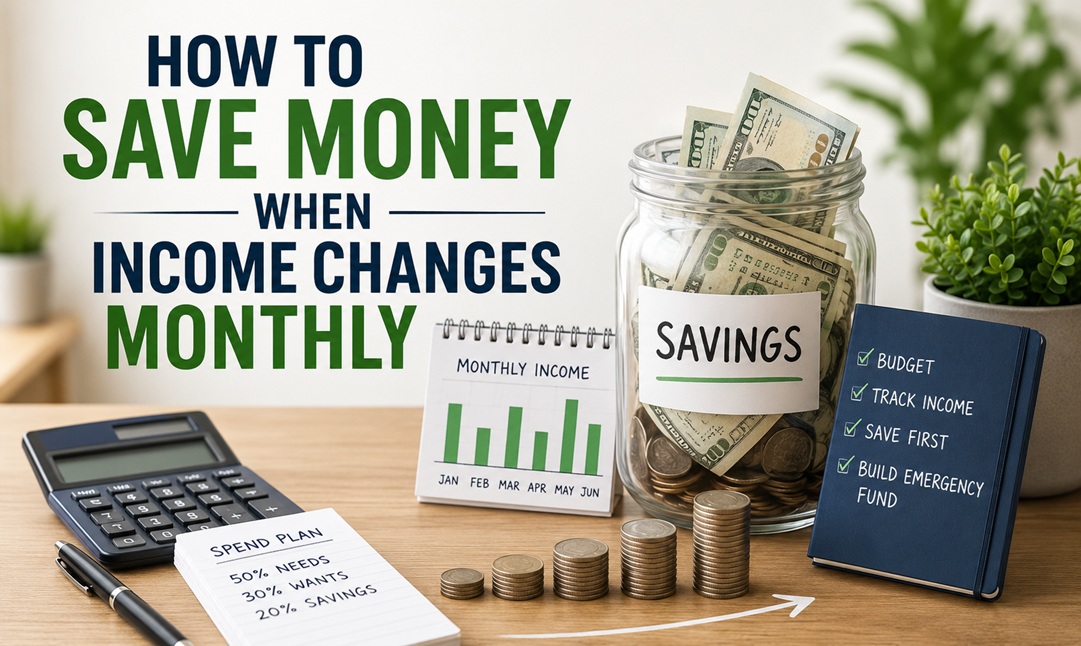
Saving money when your income is different every month is genuinely harder than saving on a fixed salary — but it is absolutely possible. The key is to stop saving a fixed amount each month and start saving a percentage instead. When you earn more, you save more. When earnings drop, your savings contribution drops too, but you never skip it entirely. This percentage-based approach adapts naturally to income swings without requiring a rigid monthly number.
The Problem With Standard Saving Advice
Most saving advice assumes a steady paycheck. ‘Save 20 percent of your income’ sounds simple when that income is the same every month. But for a freelance designer who earns $2,000 in January and $6,500 in March, a fixed savings target creates either constant shortfalls or missed opportunities.
The result is that many variable earners either give up on saving consistently or drain what they have saved during low months — then feel like they are starting over every few weeks.
The Solution: Percentage-Based Saving
The fix is straightforward. Decide on a percentage — anywhere from 10 to 25 percent depending on your situation — and transfer that proportion of every payment you receive to a savings or buffer account immediately. Not at the end of the month. At the point of income.
This is sometimes called paying yourself a savings percentage first. The money moves before you see it in your main account. What remains is what you budget to live on.
If you receive a payment of $3,000 and your savings rate is 15 percent, $450 goes straight to savings. If next month’s payment is $1,200, $180 goes. The ratio stays consistent. The absolute amount fluctuates, but the habit holds.
Building a Buffer Before True Long-Term Savings
Before building long-term savings, most variable earners need an income buffer first. This is different from an emergency fund, though the two often overlap. A buffer covers the gap between your lowest earning months and your fixed expenses.
The practical goal is to accumulate enough in a buffer account to cover two to three months of essential costs. Once that is in place, income drops become manageable rather than catastrophic.
Local Approaches Worth Knowing
In the US, a high-yield savings account at an online bank makes a reasonable buffer and savings vehicle because rates are typically better than traditional checking accounts. Some earners use separate accounts at entirely different banks to reduce the temptation to transfer money back.
In Canada, a Tax-Free Savings Account (TFSA) is worth using once your buffer is established. Contributions grow tax-free and can be withdrawn without penalty, making it a practical vehicle for variable earners who may need access.
In Australia, many self-employed workers direct savings into an offset account linked to their mortgage if they have one, effectively reducing interest while maintaining access. For those renting, a high-interest online savings account at institutions like UBank or ING serves a similar purpose.
In the UK, a cash ISA works well as a flexible savings account for irregular earners because contributions and withdrawals are unrestricted in most versions, and interest is tax-free.
Frequently Asked Questions
What percentage should I save with variable income?
Start with 10 percent if income is very inconsistent. Move toward 20 to 25 percent as earnings stabilise. There is no universally correct number — the right percentage is one you can maintain during low months without going into debt.
Should I save during a very low income month?
Yes, even if the amount is small. Saving 10 percent of $800 is $80. That is not much, but maintaining the habit matters more than the amount. Consistency across low months protects you from losing the routine entirely.
What if I have debt as well as irregular income?
Build a small starter buffer of one month of essential expenses before aggressively paying debt. Without any buffer, a single low-income month pushes you back into debt regardless of payments made.